Lofthus family house
The SonThe Lofthus family house is both the site of Ab Lofthus’s coerced death and the surviving home to which Sonny returns after years away. In Berg, the neglected yellow house holds the family’s visible past, concealed objects, and the burden of a death long mistaken for suicide; its later occupation by Sonny and Martha turns it into a temporary refuge before it is consumed by fire.
Ab Lofthus’s Death and the House’s Abandonment
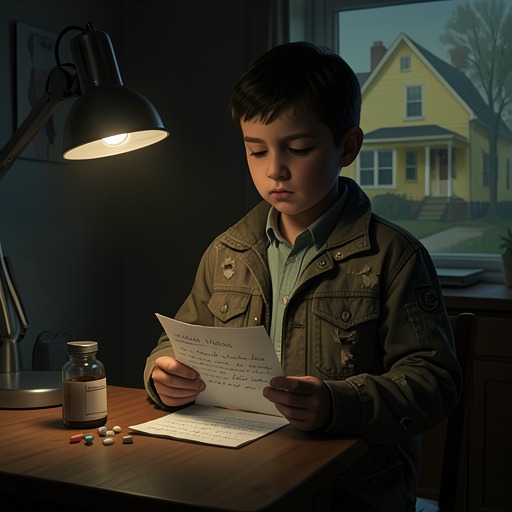
Ab was alone in the house one weekend while Sonny and his mother were away at a wrestling competition. Knowing that Nestor and his men were coming, he barricaded himself inside. They nevertheless entered. To avoid the repercussions of openly shooting a police officer, they forced Ab to write a suicide note in exchange for a promise to spare his wife and son, then killed him with his own gun. The house thus became the setting of a crime disguised as a private family tragedy.
The building remained a place apart in its street. A neighborhood boy named Markus describes it as an ordinary, box-shaped house with a small garden, but both the property and lawn had fallen into disrepair. No one had lived there for as long as he could remember. Its association with a suicide made the vacancy seem almost natural to him, and the house’s neglected rooms gave his childhood imaginings a sinister setting.
Although abandoned, the house was not entirely left to decay. Markus had seen a different visitor at least twice a year, and inferred that the man turned on the heating before winter and off again in spring. Markus’s mother believed that without power the house would have become uninhabitable, but did not know who paid the bills. That periodic care preserved the building while leaving its keeper unidentified to the neighbors.
Sonny’s Return and the Hidden Drawer
Markus’s account makes Sonny’s return visible first as a mystery. He sees a man enter by the basement stairs rather than the front door, using a key hidden on a beam above the basement entrance. The visitor goes into the bedroom Sonny had occupied, a room with dirty bedding and discarded needles. From his binoculars, Markus watches him examine photographs: the family picture, the image of Sonny as a child in a wrestling suit beside Ab holding a trophy, and Ab in his police uniform. The house’s surviving images make the absent family present to the watcher even as he misidentifies the returning son as a stranger.
The house’s private spaces preserve both access and concealment. Markus knows the key to the study drawer is hidden between books on a shelf, and he hurries inside after seeing the visitor leave. The study’s desk bears a dark mark that Markus imagines as part of the scene of Ab’s death. When he opens the drawer, he finds that its contents are gone. He concludes that the visitor must have been Sonny, since only the son could know where the key was kept; the needle marks Markus had noticed also seemed to fit the story he had heard of Sonny’s imprisonment and drug addiction.
Markus then notices further absences in Sonny’s bedroom: the photograph of Ab in uniform, a Discman, and one of four CDs, Depeche Mode’s Violator. The son has returned not simply to enter the house but to retrieve something from its hidden interior, while removing objects that connect him to his father and childhood. Through Markus’s limited but attentive perspective, the house becomes a puzzle whose clues are ordinary keys, photographs, and possessions.
A Watched Refuge
The house remains under Markus’s informal surveillance. Later, he stays awake to watch the road and recognizes Sonny by the way he walks. Sonny is staggering, dressed in a suit, with a handkerchief tied around his forehead and one hand held to his side. Markus sees him approach the house and is moved to go outside. His watching has shifted from curiosity about an abandoned building to concern for the person he has identified as the son who belongs there.
Martha also enters the house, and the narrative links its rooms to her unsettled sense of what has happened there. After waking from a dream about a woman in an attic and a trapped baby, she finds Agnete Iversen’s earrings on the kitchen counter and puts them on. The house is not merely a shelter: it gathers objects and histories that Martha cannot easily separate from her own experience.
When Martha discovers a locked freezer in the basement, she finds a body inside. The discovery turns the house’s lower level into another concealed chamber, making its apparent role as a refuge impossible to sustain. Martha hears conflicting voices urging her to leave, but the important change in the house’s meaning is concrete: the place where Sonny has sought shelter also contains a hidden death.
The contrast between the house’s private interior and the street outside continues after this discovery. Markus sees Martha leave and speak to children playing with skipping ropes, then spots Sonny at an open bedroom window. Sonny is naked, smiling, and has a bandage at his side. Markus reads the expression as happiness and associates it with his own anticipation of Christmas presents. The house briefly appears to hold a moment of peace, but Markus’s view remains that of a boy watching through binoculars, unable to know how durable that peace will be.
Separation and Destruction
Martha’s return from shopping reveals that Sonny has disappeared. The bed is empty, a lamp lies broken, and his clothes are gone; beneath the broken pieces she finds the black book she had discovered under the bed slats. The gate is open, and she believes that Sonny has been taken, as he had feared. His note on the pillow says he will disappear and that he loves her. For Martha, the house’s history of loss seems to recur in this departure, though Sonny has left a message rather than a suicide note.
The house’s final appearance is framed through Markus’s observation. After Sonny gets up, ruffles his hair, and walks away carrying a briefcase, Markus notices the curtains billowing in the open bedroom window despite the lack of wind. The curtains catch fire, and the other windows are open as well. The house seems to draw in air as the fire grows. Its destruction closes the life of the building that had stood as a neglected memorial to Ab’s death, a hidden store of Sonny’s past, and a temporary shelter for Sonny and Martha. Through Markus’s neighborhood vantage point, its burning is at once a literal ending and the culmination of the house’s long, uneasy presence in the street.